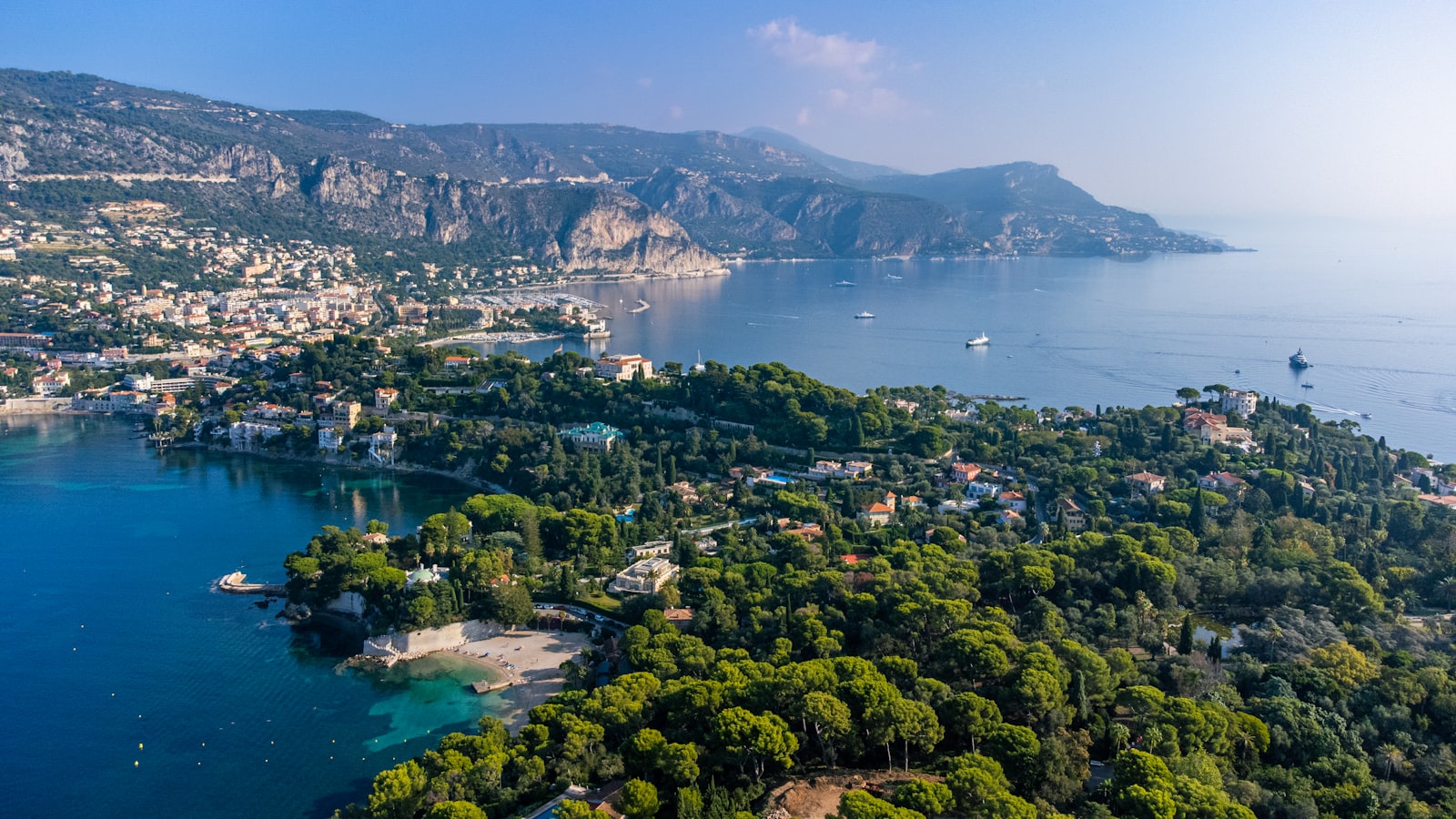

The French Riviera is smaller than it looks in your head, and that's the good news. The whole famous stretch — Cannes to Menton, with Nice in the middle — is about 60 kilometres of coast, laced together by a cheap regional train that runs along the water all day. You don't need to pick one town and stay put, and you don't need a car for most of it. Base yourselves well, learn the train, and in a week you can swim off a dozen beaches, climb a village on a cliff, lose an afternoon in Monaco, and still take every lunch slowly. Here's how to put it together.
Getting in, and getting around
Fly into Nice. Then let the coastal train do the work.

Nice Côte d'Azur (NCE) is the obvious front door — France's third-busiest airport, right on the sea, with a tram (line 2) that runs from the terminals to the port and city centre in about half an hour for a couple of euros. From there, the star of the whole region is the coastal train: the regional TER line hugs the shore from Cannes through Antibes, Nice, Villefranche, Monaco, and Menton, all the way to Ventimiglia in Italy. Tickets are a few euros, trains run every 20–30 minutes, and the stretch east of Nice — cliffs, coves, and superyacht harbours flashing past the window — is one of the best-value views in France. Skip the rental car for the coast; grab one only for the vineyard-and-village days inland, where the train doesn't reach.
Where to base yourselves
Nice for the middle of everything; Villefranche or Antibes to slow it down.

Nice is the right answer for most groups: it's the transport hub, it has the range of places to stay and eat, and Vieux Nice — the old town — is a warren of ochre lanes, socca stands, and a market square that's the heart of the whole trip. Stay in or near it and you can walk to the beach and roll onto any train. If you want the coast quieter and prettier, Villefranche-sur-Mer — one deep blue harbour ten minutes east by train — is hard to beat, and Antibes, to the west, gives you a sandy beach, a great market, and a Picasso museum. For a whole group, renting an apartment usually beats splitting across hotel rooms: you get a kitchen for the market haul, a terrace for the rosé, and a per-night number that drops fast once you divide it.
One apartment, not five hotel rooms
A two- or three-bedroom apartment in Vieux Nice or old Antibes usually undercuts the equivalent hotel rooms, hands you a kitchen for the socca and peaches you'll haul back from the Cours Saleya, and gives everyone a terrace to land on between swims. The easiest way in: Nice Pebbles, a long-running English-speaking agency with a big book of vetted old-town apartments, honest photos, and an actual human on the phone when the lockbox jams. Or work the two-tab trick — find a place you like on Airbnb or Booking, then search its name and photos; managed properties usually have their own site with the same weeks 10–15% cheaper. Rent the whole place, split it evenly, and the nightly cost gets friendly quick.
The coast, one town at a time
Villefranche, Èze, Monaco, Antibes, Menton — all a short hop apart.

Here's the Riviera's superpower: everything is close. From Nice, Villefranche-sur-Mer is ten minutes by train — a horseshoe of pastel houses around a harbour deep enough for cruise ships, with a rare stretch of soft beach and a medieval covered lane, the Rue Obscure, to duck into. Èze, a stone village clinging to a peak 400 metres above the water, is a short bus or a stop-and-climb away. Monaco is 25 minutes east; Menton, all lemon-yellow and Italianate, sits one stop from Italy. West of Nice, Antibes and Cannes are 20–35 minutes by train. You could spend a week here and never drive, never repeat a beach, and never eat the same lunch twice. The activities guide lays out the full day-trip hit list.
- Villefranche-sur-Mer — a jewel-box harbour, 10 minutes east by train.
- Èze — a medieval village on a cliff over the sea, up the Moyenne Corniche.
- Monaco — the casino, the Rock, the yachts; 25 minutes east.
- Antibes & Cannes — sandy beaches, markets, and the Îles de Lérins, 20–35 minutes west.
- Menton — pastel, sun-baked, and one stop from Italy.
The perched villages and the corniches
The best afternoons are up in the hills, looking back at the sea.

The coast is only half the Riviera. Behind it, the land jumps straight up into stone villages that have watched the sea for a thousand years. Èze is the showstopper — a car-free knot of lanes spiralling to a cactus garden at the summit, with the whole Mediterranean laid out below. Inland, Saint-Paul-de-Vence is a fortified art village of galleries and the great Fondation Maeght, and nearby Vence hides a chapel Matisse designed down to the last candlestick. Threading it all together are the three corniches — the low coastal road, the middle one through Èze, and the high Grande Corniche with the panorama that Hitchcock filmed. Rent a car for a day, take the high road out and the low road back, and stop wherever the view makes you.
Take the Grande Corniche at golden hour, when the whole coast turns to copper and the sea goes navy. That's the drive people remember.— On the high road above the sea
How long, and a shape for the days
Four nights to taste it; a week to actually relax.
A long weekend gives you Nice and one or two neighbours; a week lets the coast do what it's for. A shape that flows: Day 1, land, drop bags, and give the evening to Vieux Nice — the market square, a socca stand, dinner as the light goes. Day 2, the Cours Saleya market and a swim off the Nice pebbles, then the Chagall or Matisse museum. Day 3, the train to Villefranche and the coastal path around Cap Ferrat. Day 4, Monaco and Èze up the corniche. Day 5, west to Antibes and Cannes, or a boat day on the water. Leave a slot with nothing planned — on the Riviera that's usually the beach-club lunch that quietly becomes the whole afternoon.
When to go
Late spring and September — the sea's warm and the crowds aren't.
Come May to June or September: long hot days, a sea that's actually swimmable, and terraces in full swing without the August wall of people. September is the quiet winner — the water's at its warmest after a whole summer of sun, the light turns golden, and prices ease off. July and August are gorgeous but heaving and pricey, and the coast books out; if you come then, reserve everything early. Spring brings the region's festivals — Menton's Fête du Citron and Nice's Carnival in February, the Cannes Film Festival and the Monaco Grand Prix in May — which are a thrill to catch and a nightmare for beds, so plan around them either way. Winter is mild, cheap, and lovely, with the museums empty and the light low and clear.
Where we would book
For the apartment: go through Nice Pebbles for a vetted old-town flat, or use the two-tab trick — find the listing on Airbnb or Booking, then search the property's name and book the same weeks direct, usually 10–15% cheaper once the platform fee drops out. Confirm two things before paying: the listing shows a French tourist-registration number (legit rentals in Nice display one), and the sleeping count means beds, not sofa cushions. Buy train tickets straight from SNCF Connect or the regional Zou! site (or just tap in at the station); there's no reseller worth a markup on a €4 coastal train. Rent any corniche-day car ahead — automatics sell out, and Nice airport is the cheapest place to collect one. For the Monaco Oceanographic Museum, the Fondation Maeght, and the Nice art museums, buy from their official sites, not a reseller charging extra for the same entry. And the best thing here — the coastal path, the market, the sea — is free. No middleman required, so we skip it.
Related guides
- French Riviera Food Guide — socca, the real salade niçoise, and rosé all day.
- Things to Do on the French Riviera — the corniches, the beaches, Monaco, and a boat day.
- French Riviera Culture Guide — the light that pulled the painters here.
- Your Bordeaux Travel Guide — France's other coast, swapped for wine country and the Atlantic.
- French Riviera Group Trip Guide — the same coast, planned for six or ten of you.